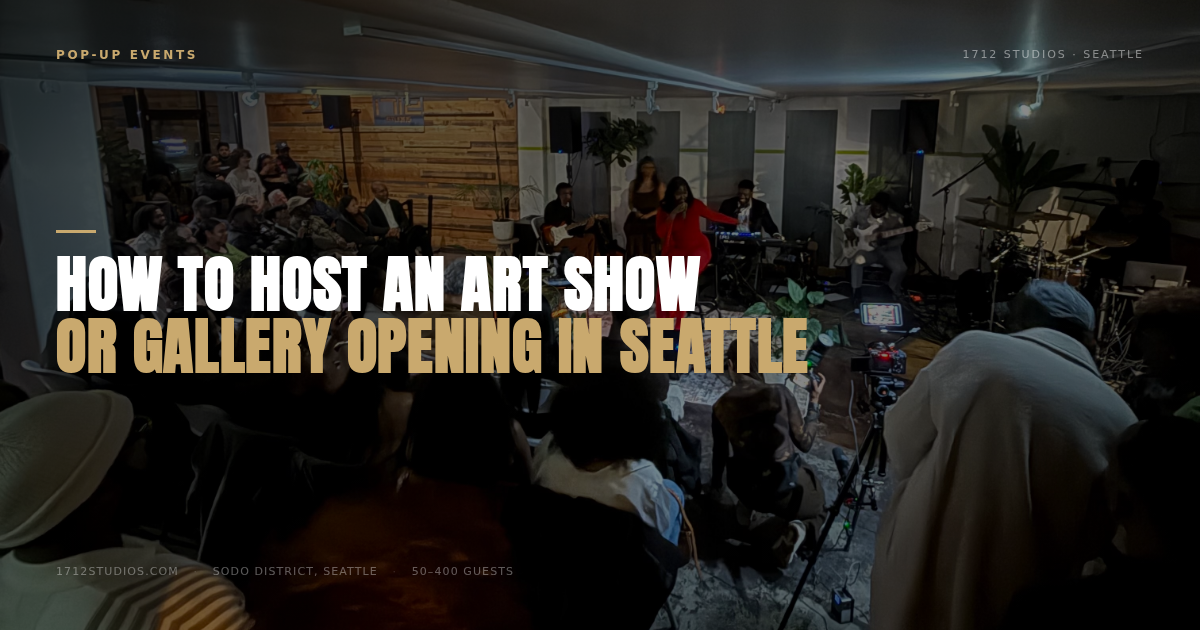
Hosting an art show in Seattle takes more than good work and a guest list. The venue, the layout, the lighting, the flow of the night, all of it shapes how people experience the art and whether they actually buy. If you're planning a gallery opening, pop-up show, or artist showcase in Seattle, here's what you need to know before you book anything.
Start With the Right Space
Gallery openings don't belong in generic event halls with drop ceilings and carpet. You want raw space, high ceilings, open floor plans, and neutral surfaces that let the work breathe. Industrial and warehouse-style venues tend to work best because they give you flexibility without competing with the art visually.
1712 Studios, located in Seattle's SODO district at 1712 1st Ave S, is a 6,000 sq ft warehouse venue that works well for this exact reason. The open layout gives you room to arrange work however you want, linear wall runs, freestanding display panels, sculpture in the center, without the space dictating your layout to you. It holds up to 300 guests, so it scales whether you're doing an intimate 80-person opening or a large public show.
Plan Your Layout Before You Commit to a Venue
Most artists make the mistake of booking first and figuring out the layout later. Do it in reverse. Sketch out roughly how many pieces you're showing, what wall space you need, whether you need freestanding panels or pedestals, and how you want foot traffic to move through the space.
A good gallery layout guides people through the work in a deliberate sequence. You want a natural entry point, a clear path, and a moment of pause, usually near your anchor pieces. If people are bunching up at the entrance or skipping entire sections of the room, the layout isn't working.
Allow Space for People, Not Just Art
At a gallery opening, you need room for conversation. A piece that looks perfectly spaced on paper can feel cramped once 120 people are standing around with drinks in their hands. Budget at least 10 to 15 square feet per guest when the room is at capacity, and make sure your focal pieces have breathing room on all sides.
Lighting Is Everything
If your venue can't support proper lighting for the work, walk away. Overhead fluorescents kill art. You want directional lighting, track lights, spots, or adjustable fixtures, that you can aim at individual pieces. If the venue doesn't have this built in, factor in the cost of renting and rigging lighting before you commit.
Also consider the color temperature of the bulbs. Warm light (around 2700K, 3000K) works for photography and painting. Cooler light (4000K+) can work for sculpture or digital work. Get this wrong and even great work looks flat.
Think Through the Full Guest Experience
An art show is still an event. People arrive, they need somewhere to put their coat, they want a drink, they'll look for the bathroom. The parts of the night that have nothing to do with the art will affect how people feel about the art. Get the basics right.
Think about: how guests are greeted at the door, where you're serving drinks and food (and whether it's in a spot that creates a bottleneck), where the artist or curator will be positioned for conversations, and how you're handling sales or inquiries if work is for sale.
Sound and Ambiance
Background music sets tone without demanding attention. Keep it low, keep it consistent, and make sure whoever is managing it doesn't take requests that derail the mood. If your venue has a built-in sound system, 1712 Studios includes one at no extra charge, that's one less vendor to coordinate.
Logistics That Artists Often Overlook
Installation time is always longer than you think. Book your venue for at least a few hours before doors open to hang work, adjust lighting, and troubleshoot. Make sure you understand load-in logistics: Is there a freight entrance? An elevator? Ground-floor access? For large or heavy pieces, this matters.
Also confirm what's included in your venue rental. Surprise fees for tables, chairs, parking, or AV equipment can add up fast. 1712 Studios includes tables, chairs, parking, and sound equipment in the base rate, no itemized add-ons at the end.
Ready to Book Your Art Show in Seattle?
If you're looking for a flexible, open warehouse space in Seattle that won't nickel-and-dime you, reach out to 1712 Studios directly. You can visit 1712studios.com to check availability or call (206) 594-4809 to talk through your event. The venue is available until 2am with six hour packages, so there's room to build a proper opening night, not just a two-hour sprint.