Most Business Mixers Don't Work, Here's Why
If you've ever left a networking event with a pocket full of business cards and zero follow-up conversations, you already know the problem. Most business mixers are designed to feel productive without actually being productive. Open bar, light appetizers, name tags, and a room full of people talking to the three people they already know.
A well-executed business mixer should do one thing: generate leads. That means new relationships that have a realistic path to becoming clients, partners, or referral sources. Everything about how you plan the event should work toward that outcome. Here's how to make it happen.
Start With a Targeted Guest List
The biggest mistake organizers make is chasing headcount instead of fit. Two hundred people who have nothing in common will generate far fewer leads than sixty people who all operate in adjacent industries.
Build your guest list around a specific professional ecosystem. If you're in commercial real estate, invite lenders, contractors, attorneys, and property managers, not just other brokers. If you're in tech, curate a room of founders, investors, and operators at a similar stage. When people in the room actually need each other, conversations start themselves.
Cap your invite list intentionally. A room that feels full but not overcrowded, somewhere between 80 and 150 people for most mixers, creates the right energy. Too small and it feels like a dinner party. Too large and it becomes impossible to work the room.
Design the Space to Force Interaction
Your venue layout is a networking tool. Most people default to standing against walls or clustering near the bar. Your job is to create physical reasons for people to move and mix.
Use high-top tables scattered throughout the room rather than rows of seating. Create a few distinct zones, a conversation area near the front, a drink station in the middle, a food station toward the back, so guests have reasons to travel through the space. Avoid any setup that lets people plant themselves in one spot for the whole night.
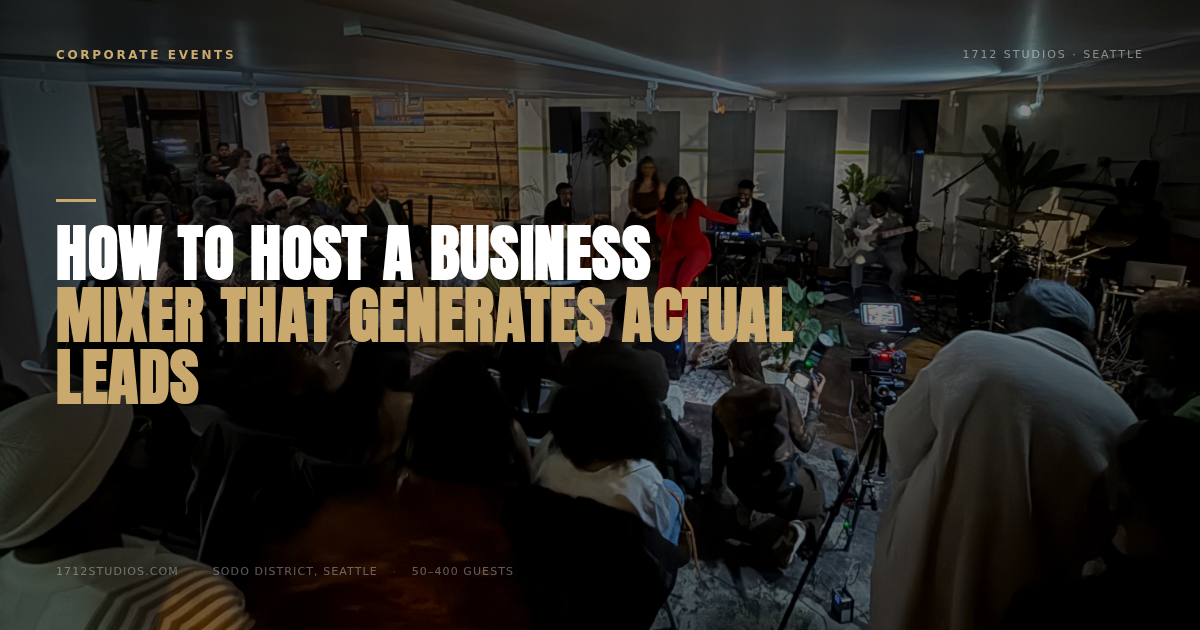
This is one reason industrial warehouse venues work well for mixers. Spaces like 1712 Studios in Seattle's SODO district give you a raw, open 6,000 square feet that you can configure exactly how your event needs. No fixed walls pushing people into corners, no banquet hall layout defaulting you into rows. You control the flow.
Build In a Structured Element
Pure open networking is inefficient. Add at least one structured element that gives people a reason to talk to someone new.
A 10-minute facilitated introduction round at the start of the event works well. Ask everyone to introduce themselves with their name, company, and one specific thing they're looking for right now, a vendor, a hire, a partnership. You'll watch the room shift immediately as people self-select toward conversations that have actual potential.
Alternatively, run a short panel or speaker segment early in the evening. A 20-minute talk on a relevant topic gives everyone shared context and instant conversation fodder. It also gives your brand a platform and positions you as a credible host.
Make Follow-Up Impossible to Forget
The lead generation doesn't happen at the event, it happens in the 48 hours after. Build your follow-up infrastructure before the event, not after.
Set up a simple shared resource: a LinkedIn group, a post-event email with a guest directory (with permission), or even a group text thread for attendees. Give people a low-friction way to reconnect after the night ends. Send your own personal follow-up emails within 24 hours while the conversations are still fresh.
If you're planning a recurring mixer series, which you should be, document what worked and what didn't immediately after the event. The second event is always better than the first.
Get the Logistics Right So Nothing Gets in the Way
A great mixer can be derailed by bad logistics. Parking issues, a sound system that cuts out, not enough seating, surprise fees that blow your budget, any of these create friction that pulls attention away from the actual networking.
Choose a venue that handles the infrastructure so you can focus on the people. When we've seen clients host mixers at 1712 Studios, one thing that consistently comes up is that the all-inclusive setup, sound system, DJ booth, tables, chairs, and parking all included with no surprise fees, lets the organizer actually be present at their own event instead of running around solving problems.
The details matter. A space that's easy to get to, easy to park at, and professionally equipped removes every excuse for a guest not to show up and stay engaged.
The Bottom Line
A business mixer that generates leads isn't an accident. It's the result of a targeted guest list, a layout designed for movement, at least one structured interaction, and a follow-up plan that's ready before the first guest arrives. Get those four things right and you'll walk away with conversations that actually go somewhere.
If you're planning a mixer in the Seattle area and want a venue that's built for this kind of event, reach out to 1712 Studios at (206) 594-4809 or visit 1712studios.com to check availability. The space holds up to 300 guests, is available until 2am, and comes with everything you need included in the price.