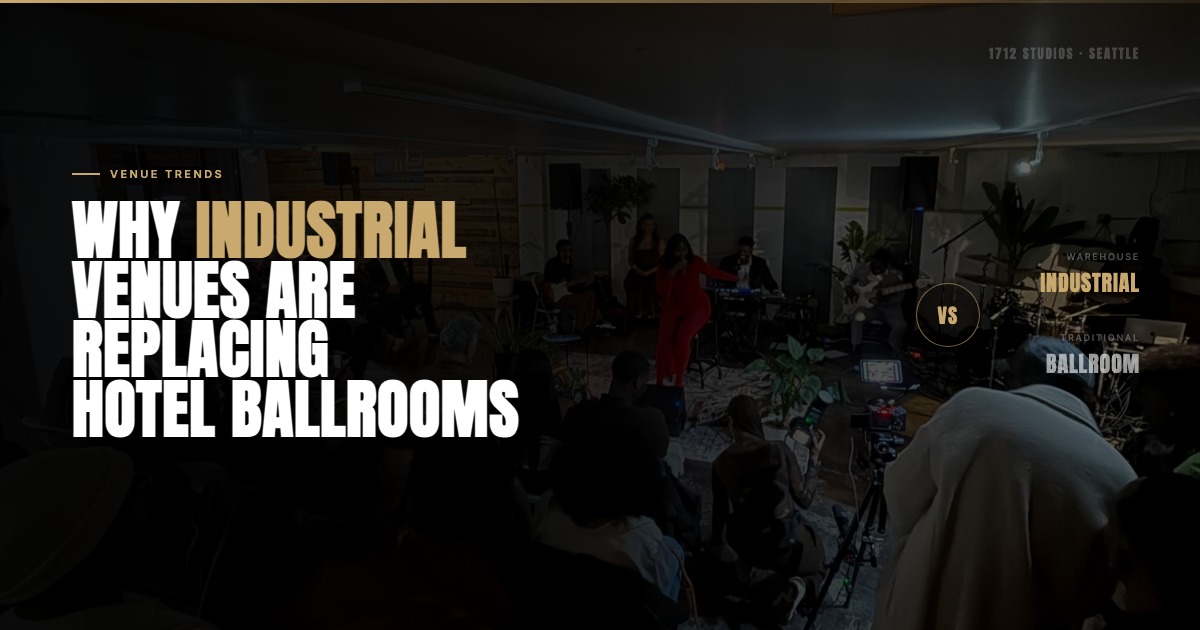
Why Industrial Venues Are Replacing Hotel Ballrooms in Seattle
For decades, the default answer for corporate events, fundraisers, and larger gatherings in Seattle was the hotel ballroom. Predictable, accessible, forgettable.
That's changing. Industrial warehouse venues are pulling events away from hotels at every budget level, and the shift isn't just aesthetic. There are real, practical reasons planners are choosing raw warehouse space over polished hotel infrastructure.
The Problem with Hotel Ballrooms
Hotel ballrooms have a built-in constraint: they were designed to look the same for every event. The beige carpet, the drop ceiling, the pre-set round tables, everything is configured for a generic guest. You're renting a template, not a canvas.
Beyond aesthetics, hotel venues come with restrictions that add friction and cost:
- Vendor exclusivity, most hotels require you to use their in-house catering, bar service, and AV team
- Curfews, hotel events typically end by 11pm or midnight
- Minimum spends, many ballrooms require a food and beverage minimum unrelated to your event size
- No flexibility, non-standard load-in requests are rarely accommodated
What Industrial Venues Offer Instead
Control. You bring your own vendors, your own catering, your own vibe. No exclusivity agreements, no mandatory add-ons.
Hours. In Seattle's SODO district, venues like 1712 Studios are permitted until 2am. Your event ends when you decide it ends.
Cost. Without mandatory food and beverage minimums or AV upcharges, industrial venues are often significantly more cost-effective, especially when you're handling catering yourself or working with outside vendors.
Visual impact. Exposed brick, concrete floors, steel beams, and raw ceiling height create a setting that photographs differently than every other corporate event on someone's LinkedIn feed.
The Seattle Market Specifically
Seattle's creative and tech industries have accelerated this shift. Product launches, company all-hands events, brand activations, and team celebrations increasingly need a space that reflects the company's identity, not a generic hotel package.
The same shift is happening in the social event market. Weddings, milestone birthdays, and fundraisers in industrial spaces have a distinctly different energy. They feel intentional. Curated.
What to Look For in a Seattle Industrial Venue
Not all warehouse spaces are created equal. Before you book, verify:
What's actually included. Some spaces are genuinely raw with no furniture or sound. Others come fully loaded. At 1712 Studios, every rental includes 100+ chairs and tables, a full Mackie sound system, a DJ booth, a 110" display screen, high-speed WiFi, a bar area, a dressing room, and a studio manager on-site.
Load-in access. Corporate and production events need infrastructure. Look for a venue with a garage door and freight access.
Parking. Seattle's industrial corridors have better parking than most of the city. Confirm private spots and available street parking.
Capacity range. Know your guest count range and find a venue with configurations to match.
See 1712 Studios' three configurations and rates here.
Making the Switch
If you've been defaulting to hotel ballrooms out of habit, it's worth running the numbers on an industrial alternative. Take your last hotel event budget. Break out what you paid for venue, catering minimums, mandatory AV, and after-hours fees. Then price a warehouse rental where you control every variable.
The math usually isn't close.
Book a free 30-minute tour at 1712 Studios and see the space before you commit to anything. Most people who tour make their decision the same day.