Running a pop-up in Seattle sounds exciting until you add up your costs and realize you barely broke even. The problem isn't the product — it's the pricing. Most vendors set prices based on gut feeling or what competitors charge, without ever working backward from their actual expenses. Here's how to fix that.
Start With Your True Cost of Sales
Before you price a single item, you need a complete picture of what it costs to run your event. This means every line item: product costs, packaging, payment processing fees, staff, marketing, and your venue. Don't estimate — get real numbers.
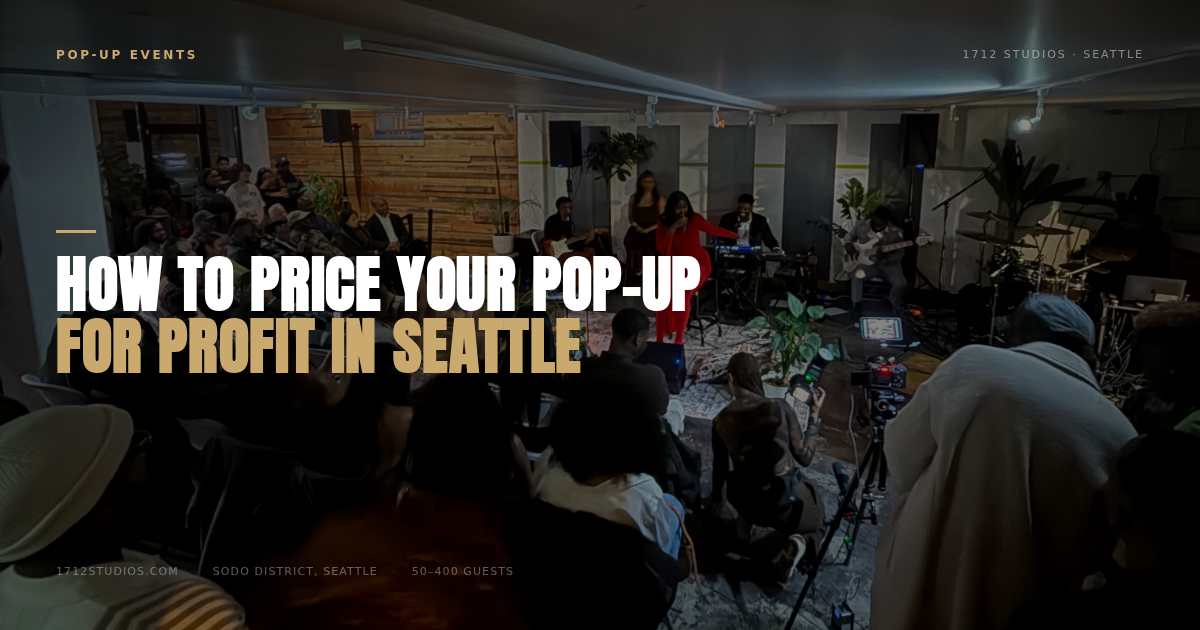
Venue cost is often where people get surprised. A space that looks affordable can turn into a budget nightmare once you add equipment rentals, parking fees, and surprise add-ons. When you're scouting locations, look for venues with transparent, all-inclusive pricing. For example, 1712 Studios in Seattle's SODO district includes sound, a DJ booth, tables, chairs, and parking in their base pricing — no hidden fees. Knowing your exact venue cost upfront lets you build a pricing model that actually holds up.
Calculate Your Break-Even Point First
Your break-even point is the minimum revenue you need to cover all costs. Calculate it before you set a single price.
The Basic Formula
Add up all your fixed costs for the event — venue, permits, staffing, marketing. Then add your variable costs per unit sold. Divide your total fixed costs by your average margin per unit, and you'll get the number of units you need to sell just to break even. Anything above that is profit.
If those numbers feel too tight, you have two options: reduce costs or raise prices. Most vendors are afraid to raise prices, but buyers at pop-ups in Seattle expect to pay a premium for local, curated goods. Don't undercut yourself to compete with retail.
How to Set Prices That Actually Earn
Use a Keystone Markup as Your Floor
Keystone pricing — doubling your cost of goods — is the traditional retail baseline. For a pop-up, treat this as your absolute minimum, not your target. You have higher overhead than a permanent store and less time to convert sales. Your margin needs to be higher to compensate.
Price for the Room, Not the Internet
People at a pop-up are in a buying mood. They're there to discover and spend. Price your items for the experience and the moment, not to match your Etsy or online store. You can always note that online prices are different — that's a feature, not an inconsistency.
Create a Tiered Product Mix
Have entry-level products that draw people in, mid-tier items that make up the bulk of your sales volume, and high-ticket items that dramatically increase your average transaction. If every item is priced the same, you're leaving money on the table. A well-structured product mix can double your revenue without doubling your traffic.
Factor in the Cost of Foot Traffic
Not every pop-up venue is equal when it comes to driving traffic. Some spaces sit on busy corridors with natural walk-by traffic. Others require you to bring every single guest yourself through marketing and promotion. That cost — your time, your ad spend, your email list — needs to be factored into your pricing.
This is one reason why choosing the right venue matters strategically, not just logistically. A space like 1712 Studios, with 6,000 square feet and capacity for up to 400 guests, gives you room to scale an event large enough to make your marketing investment worthwhile. Running a pop-up for 50 people in a space built for 400 is fine — but running a well-promoted event that fills a room changes your economics entirely.
Build In a Profit Target, Not Just a Break-Even
Here's the mindset shift most pop-up vendors need: break-even is failure with extra steps. You spent time, energy, and money. You should walk away with profit. Before your event, set a clear profit goal — whether that's a dollar amount or a percentage of total revenue. Then reverse-engineer your pricing and sales targets to hit it.
If your numbers say you can't hit your profit goal at prices the market will bear, that's critical information. It means you need to cut costs, find a more efficient venue arrangement, or reconsider the event format altogether. Better to know that before you set up your table.
Ready to Run a Pop-Up That Pays?
The difference between a profitable pop-up and a frustrating one usually comes down to planning — and pricing is at the center of that plan. If you're looking for a Seattle venue that gives you a clear cost, flexible capacity, and everything included so you can model your budget accurately, reach out to 1712 Studios at (206) 594-4809 or visit 1712studios.com to check availability and get a quote.