Start With the Goal, Not the Guest List
Before you book anything, get clear on what success looks like for your launch. Are you trying to generate press coverage? Close deals with buyers in the room? Build buzz with influencers and early adopters? The answer to that question shapes every decision that follows — venue size, layout, programming, and how you structure the night.
A launch event for a B2B software product looks nothing like a launch for a consumer brand. One might need a quiet space for one-on-one demos and investor conversations. The other needs energy, music, and an environment that feels like the brand itself. Lock in the objective first, then build around it.
Choose a Venue That Works as Hard as You Do
The venue is not just a backdrop. It communicates something about your brand the moment guests walk in. In Seattle, you have options ranging from hotel ballrooms to rooftop spaces to industrial warehouse venues — and each sends a different message.
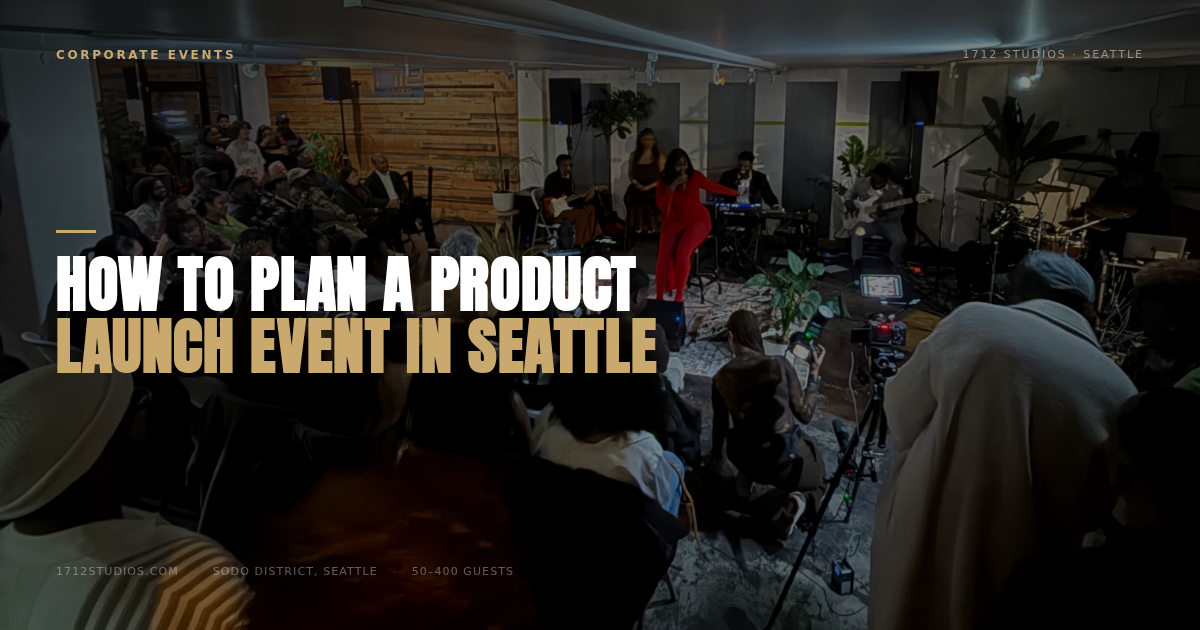
For brands that want an edge, a raw industrial space tends to photograph well, gives you full creative control, and doesn't compete with your product for attention. 1712 Studios in Seattle's SODO district is a good example of this. It's 6,000 square feet of open warehouse space that you can configure however the event requires — product demo stations, a presentation stage, a reception area, or all three. It holds up to 400 guests and comes with a full sound system, DJ booth, tables, chairs, and parking already included. No hidden fees, which matters when you're already managing a launch budget with a hundred line items.
When evaluating any venue, ask about load-in time, AV capabilities, catering flexibility, and how late the space is available. Launches often run long. A venue that cuts you off at 10pm creates unnecessary stress.
Build a Run-of-Show Before You Build Anything Else
The run-of-show is your minute-by-minute event script. Most first-time launch planners skip this or treat it as an afterthought. That's usually where things go sideways.
Key moments to map out:
Doors open and arrival window. Give guests 30–45 minutes to arrive, grab a drink, and explore before any formal programming begins. Don't waste this time — this is when your product displays and demo stations do their best work.
The main presentation. Keep it tight. Ten to fifteen minutes is usually enough to tell the story, show the product, and land the message. Longer than that and you start losing the room.
Demo and mingling time. After the presentation, open the floor. This is where the real conversations happen. Have knowledgeable team members stationed at demo areas, not clustered near the bar.
A defined end time. Events that drift on without a clear ending leave people with a flat feeling. Build in a natural close — a thank-you from a founder, a final toast, something that signals the night landed intentionally.
Handle the Logistics That Kill Events
Great ideas fall apart in execution. Here are the logistics that get overlooked most often:
RSVPs vs. actual attendance. Expect 50–70% of RSVPs to show. Plan your catering, seating, and staffing accordingly. Don't order for 200 people if 120 typically walk through the door.
AV and tech rehearsal. Book your venue for a tech run-through the day before or the morning of. A microphone that cuts out during your founder's product demo is not a recoverable moment.
Photography and content capture. Decide in advance what you need — product shots, crowd shots, candid moments, social clips. Brief your photographer on the priority list so you're not hoping they got the right angles.
Press and media coordination. If you're inviting press, designate one person to manage those relationships the night of. Don't leave it to chance.
Seattle-Specific Considerations
Seattle crowds tend to be punctual, tech-savvy, and less impressed by spectacle than by substance. Lead with the product. Be direct about what it does and why it matters. The city has a strong startup and creative community, and word travels fast — which works in your favor if the event is good, and against you if it isn't.
SODO is an increasingly popular event corridor, and venues like 1712 Studios at 1712 1st Ave S put you close to downtown without the parking and access headaches that come with more central locations. That's a practical detail, but guests notice when getting to your event is easy.
Ready to Book Your Launch Venue?
If you're planning a product launch in Seattle and want a flexible, fully equipped space that fits groups from 50 to 400, reach out to 1712 Studios directly. You can visit 1712studios.com to check availability or call (206) 594-4809 to talk through what your event needs. No pressure, no sales runaround — just a straight conversation about whether the space works for you.