You've booked the venue, locked in your lineup or agenda, and set up your ticketing page. Now you need people to actually show up. Paid ads are an option, but before you spend a dollar, there's a channel that Seattle event organizers consistently underuse: local Facebook groups.
Done right, Facebook group promotion is free, fast, and surprisingly effective. Done wrong, it gets you banned from groups before your event even launches. Here's how to do it right.
Why Facebook Groups Still Work in Seattle
Seattle has a dense, active network of local Facebook groups covering nightlife, music, food, networking, neighborhoods, and subcultures. Many of these groups have tens of thousands of engaged local members who are actively looking for things to do. Unlike Instagram or TikTok, where you're fighting an algorithm for reach, Facebook group posts land directly in front of people who opted into that community.
The key difference between a group and a page is intent. People join a "Seattle Events This Weekend" group because they want event recommendations. That's a warm audience before you say a single word.
Find the Right Groups First
Don't blast every Seattle group you can find. That approach gets you flagged as spam. Instead, build a short list of groups that are actually relevant to your event type.
Groups worth targeting in Seattle:
- Seattle Events, Meetups and Things To Do
- Seattle Nightlife and Entertainment
- Seattle Professionals and Networking (for corporate or mixer events)
- Neighborhood-specific groups like Capitol Hill Community, Ballard Locals, or SODO and SoDo area groups
- Interest-specific groups tied to your event theme (music genres, fitness, art, food)
Join each group a few days before you plan to post. Read the rules. Many groups have specific days for event promotion or require mod approval. Respecting that process keeps you in good standing and actually improves your post visibility.
Write a Post That Gets Clicks, Not Eye Rolls
Most event promotion posts in Facebook groups fail because they lead with the flyer and nothing else. A flyer is not a pitch. You need a short, conversational hook that gives people a reason to care in the first two lines.
Structure that works:
Line 1: Who this is for or what's happening. Be specific. "Seattle hip-hop heads, this one's for you" lands better than "Come to our event."
Line 2-3: The core details. Date, time, location, vibe. Keep it tight. People skim.
Line 4-5: One compelling reason to come. A headliner, a unique experience, a limited ticket count, early pricing.
Line 6: The link. Put it at the bottom, not the top.
Then attach your flyer as an image. Posts with images get significantly more engagement than text-only posts.
Timing Your Posts for Maximum Visibility
For a Friday or Saturday event, your ideal posting windows are Tuesday evening and Thursday afternoon. Tuesday catches people in mid-week planning mode. Thursday catches the "what am I doing this weekend" crowd.
Post in your highest-priority group first, then spread to others over 24 to 48 hours. Avoid posting the same copy word for word across every group. Minor variations help you avoid getting flagged and let you test what messaging lands better.
If your event runs on a weeknight, focus your posts on the Sunday and Monday before it. Weeknight events need a longer lead time to overcome the inertia of staying home.
Engage After You Post
Reply to every comment. Answer questions fast. A post with active replies signals to Facebook's algorithm that the content is worth showing to more people. It also shows potential attendees that there's a real person behind the event.
If someone tags a friend in the comments, respond to both of them. That tag is free word-of-mouth and you should treat it like gold.
Pair Online Promotion with a Venue That Sells Itself
Your promotion works harder when the venue is easy to get excited about. When people ask "where is this?" you want the answer to do some of the selling for you.
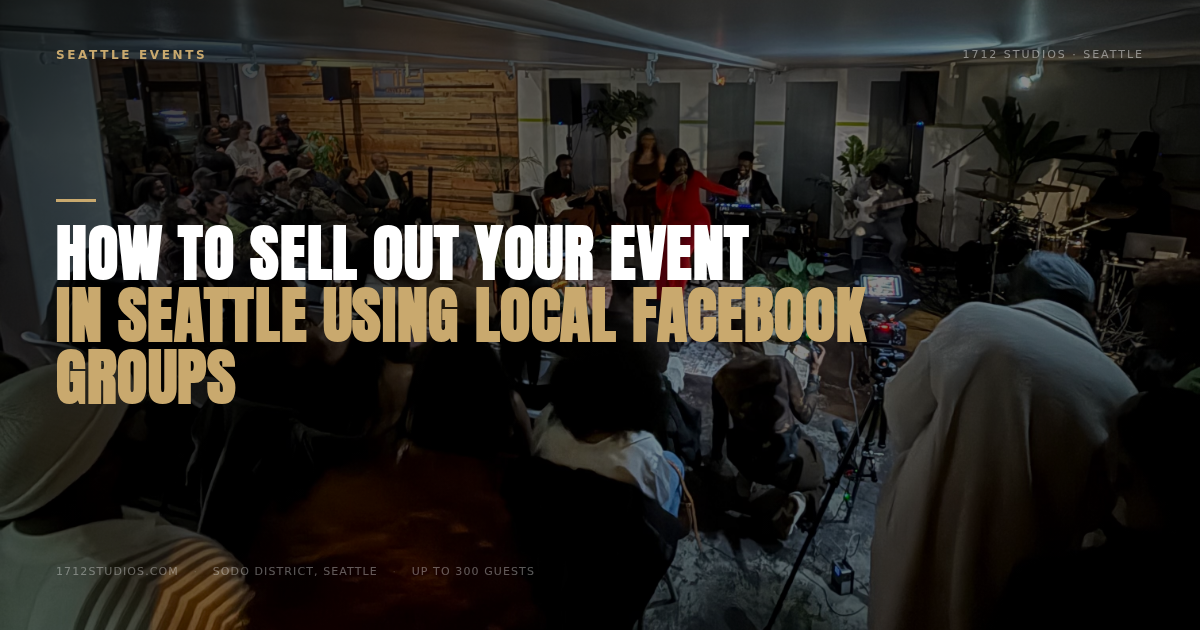
That's one reason events at 1712 Studios in Seattle's SODO district tend to generate natural social buzz. It's a 6,000 square foot industrial warehouse with a full sound system, a DJ booth, and space for up to 300 guests. When you drop that detail in a Facebook group post, it reads as legitimate. It gives people a mental picture before they even click the link.
Concrete venue details also build trust in a group setting. Vague posts get ignored. Specific ones get shared.
Don't Forget to Post Recap Content After the Event
Once your event wraps, go back to those same Facebook groups and post a short recap with photos. Thank the community for coming out. This builds your credibility as a local organizer and warms up the audience for the next event you promote. Repeat event organizers who do this consistently build a real following in these groups over time.
Venues like 1712 Studios are available until 2am, which means you'll have plenty of late-night moments worth capturing and sharing the next day.
Ready to Book Your Seattle Event?
If you're planning an event in Seattle and need a space that gives you flexibility on setup, sound, and guest count, check out 1712 Studios at 1712studios.com or call (206) 594-4809. Located at 1712 1st Ave S in SODO, it's the kind of venue that makes your Facebook group post easy to write.