Choosing a venue is one of the most consequential decisions you'll make for any event. Get it right and everything else falls into place. Get it wrong and you're fighting the space all night. Two of the most common options people consider are warehouse venues and traditional banquet halls — and while both can host a great event, they are not interchangeable. Here's a direct look at how they stack up across the factors that actually matter.
Atmosphere and Aesthetic
This is where the two formats diverge most sharply. Banquet halls are designed to be neutral — carpeted floors, drop ceilings, predictable lighting. They're built so that decorations can fill in the personality. That can work, but it also means you're starting from zero, and decor costs can climb fast.
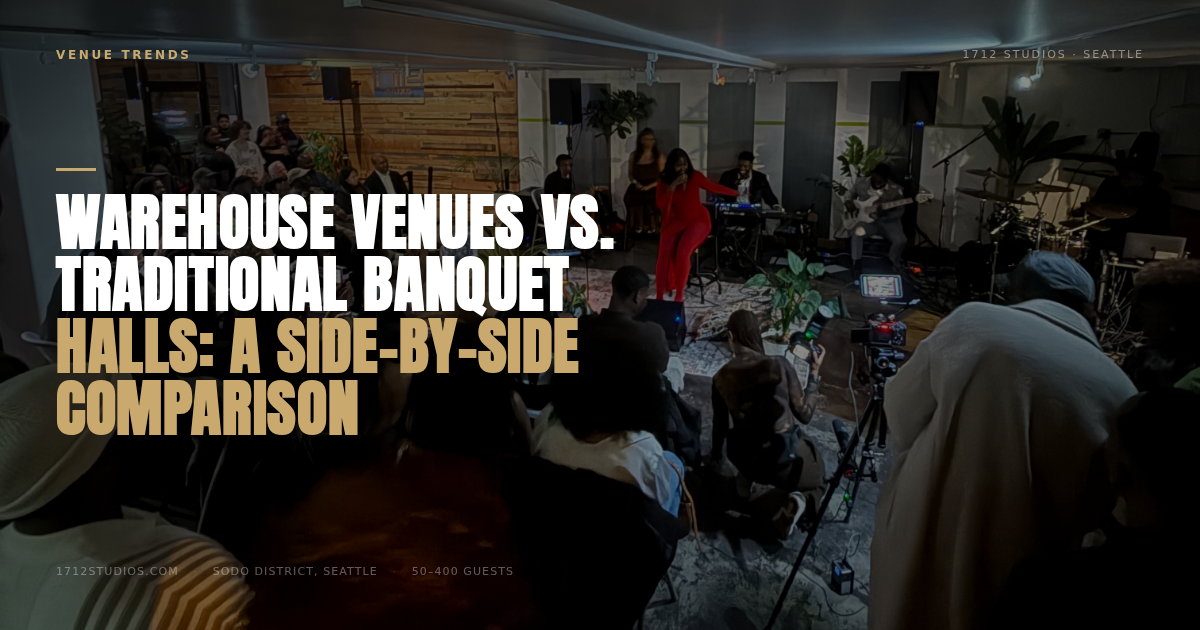
Warehouse venues bring inherent character. Exposed beams, concrete floors, high ceilings, raw industrial texture — the space itself does aesthetic work before a single guest walks in. For events where ambiance matters — corporate parties, product launches, milestone celebrations, music events — that built-in energy is a significant advantage. It's also increasingly what guests expect. The "decorated banquet hall" look has become a visual cliché; industrial spaces feel current.
Flexibility and Layout
Traditional banquet halls often come pre-configured. Rounds of eight, a head table, a dance floor in the center. There's a reason for that — it works for weddings and galas — but it limits you if your event has a different shape. Changing the layout sometimes isn't possible at all, or comes with additional fees.
Warehouse venues are open by design. You can configure the space around your event rather than designing your event around the space. A venue like 1712 Studios in Seattle's SODO district offers 6,000 square feet of open floor plan that can accommodate anywhere from 50 to 400 guests — which means the room scales to your headcount instead of feeling half-empty or overpacked.
What's Actually Included
Banquet Halls
Banquet halls typically include tables and chairs, and sometimes basic linens. Beyond that, the inclusions vary widely. Many charge separately for AV equipment, parking, setup time, and extended hours. The base rental price can look reasonable until you add everything up.
Warehouse Venues
The better warehouse venues bundle more into the base price. 1712 Studios, for example, includes a full professional sound system, a DJ booth, tables, chairs, and on-site parking — with no surprise fees and transparent all-inclusive pricing. When you're comparing costs between venue types, make sure you're comparing complete costs, not just the headline rental rate.
Sound and Technical Infrastructure
If your event involves music, live performance, speeches, or any kind of amplified audio, this matters enormously. Banquet halls were built for conversation and dining. Their acoustics and built-in AV are often an afterthought — adequate for a microphone at a podium, not ideal for anything more demanding.
Warehouse venues, particularly those that cater to events with entertainment components, tend to invest seriously in sound infrastructure. High ceilings help with volume and dispersion. A proper DJ booth and integrated sound system mean you're not renting and rigging equipment from scratch.
Hours and Operational Flexibility
Banquet halls frequently have hard cutoff times — often 10pm or midnight — tied to building management schedules or neighboring tenants. If your event has any chance of running late, that's a real constraint.
Warehouse venues in commercial or light-industrial districts have more flexibility. 1712 Studios is available until 2am, with a four-hour minimum rental. For evening events that are meant to actually feel like a night out, that headroom matters.
Location and Parking
Banquet halls are often located in suburban areas or attached to hotels, which makes them easy to drive to but sometimes disconnected from the energy of a city. Warehouse venues tend to sit in urban cores or transitional neighborhoods — which can cut both ways. The tradeoff is usually easier access to the character of a city versus easier parking.
SODO is a practical exception. It's minutes from downtown Seattle with direct highway access and on-site parking — you get the industrial aesthetic without the logistical headache that sometimes comes with urban venues.
Which One Is Right for Your Event?
If you're planning a traditional seated dinner with formal service and your guest list expects a classic setup, a banquet hall may genuinely be the better fit. But if your event calls for flexibility, atmosphere, strong sound, and late hours — a warehouse venue almost always delivers more for the money.
For events in Seattle, 1712 Studios is worth a direct look. The space handles corporate events, private parties, concerts, and everything in between without requiring you to rebuild it from scratch.
Get in Touch
Ready to see the space or get a quote? Visit 1712studios.com or call (206) 594-4809 to talk through your event. No pressure, no runaround — just a straight conversation about whether the venue works for what you're planning.